I've held my tongue long enough, simply because I consider myself a nice guy.
Notre Dame head football coach Brian Kelly doesn't need me playing the role of the apologist.
And what I'm going to say is quite critical, but it is pointed criticism of an individual.
Allow me to bookmark this by saying that what follows is no invective against my former students who attend the University of Missouri. "Mizzou" no doubt offers a fine education; their journalism school is blue-chip top-rate; and their athletic move to the Southeastern Conference--while making them quite a geographical outpost of the SEC--has paid dividends in many areas.
So you got all that? I like people at Mizzou and even though my college basketball loyalties rest with my home state Kansas Jayhawks, I have nothing against Mizzou unless prodded into a corner until I snarl.
Gary Pinkel made me snarl.
Coach Pinkel, have you never considered the wisdom of keeping your mouth clamped shut?
It goes beyond wanting to bar people from the stadium for practice back in 2012 because you didn't want your team enduring distractions? (Distractions? You're in the SEC. You'll have to go into Tiger Stadium in Baton Rouge and deal with 100,000 screaming, bloodthirsty LSU fans one day. Buck up!)
The Constitution gives you the right to your opinion. It offers no protection from the public when that opinion is stupid.
Yes, blitheringly idiotic.
No independents should make the College Football Playoff to compete for a championship, you say? There are no non-conference independent teams in the NFL, you say? Right. No critical thinking textbook could defend that train wreck of illogic.
The Twitter firestorm was not only swift and fierce, but entirely justified. And Coach Kelly was even more incisive in his reply, showing that Notre Dame doesn't need a label to be excellent. And if Pinkel wants to grouse about Notre Dame, maybe he should stop playing (and scraping past in ugly fashion) the woeful triad of Southeast Missouri State, Arkansas State (won by only seven), and Connecticut (a 9-6 win preserved with an INT on a fake field goal attempt).
"We don't play the sisters of the cupcake poor." Beautiful.
Look here, Pinkel. I'm not denying the necessity of a "breather" game once in awhile. Alabama plays Middle Tennessee. Georgia will play Southern-Baton Rouge. And even my Fighting Irish will play Massachusetts, although to be honest the Mid-American Conference is a step up from the SWAC and the Sun Belt (given how Northern Illinois put the fear of God into top-ranked Ohio State this weekend). But Notre Dame has crushed Texas, a program that Charlie Strong will have playing at a high level by season's end and be in the championship picture in four to five years. We faced adversity and beat Virginia on the road when we lost our quarterback for the year. We came home and stuffed #14 and defending Orange Bowl winners Georgia Tech. We'll also be playing Clemson at Clemson; USC at home; at Pitt; at Stanford; Boston College (which went toe-to-toe with Florida State) at Fenway Park.
Yes, you have the SEC, but primarily the SEC East. And given how you've performed in the first three games, with an offense colder than a 1972 Dodge Dart on a winter morning in Alberta...I'd say the chances are a team like the Georgia Bulldogs might just pick your players clean and feed the leftovers to UGa.
Other teams might do that to Notre Dame, but it'll be after the Irish have at least tested themselves against a higher caliber of adversaries.
You're a great tactician, Coach Pinkel. You do get mileage out of your players, and your team gives my former students who now attend Mizzou some happy moments. And when they're happy, I'm happy. I love them, and if they have a great collegiate experience at Mizzou, who could complain?
But there's a reason why the Twitter zeitgeist exploded once you opened your mouth.
Keep it shut. College football has many problems. It doesn't need additional foolishness.
You can put that wisdom on the shelf next to the national championship trophies that y'all have earned.
Oh wait. You don't have any? That's right...
Sunday, September 20, 2015

Thursday, September 17, 2015
Here Come The Reviews!
Well, it is the first one, but it comes from local St. Louis native, voracious reader, and most excellent writer (and Louisiana State University graduate!) Glynn Young. Glynn is the author of two novels that are also under the Dunrobin banner, and if you haven't read Dancing Priest and A Light Shining, you need to remedy that deficit right now.
Glynn has posted a review of my latest novel in the Cameron Ballack Mystery Series, The Broken Cross, and you can find that review at his Faith, Fiction, Friends blog right here.
Happy reading, and spread the word. (And if you still haven't read Glynn's books, either, order them now! That's what the above links are for!)
Glynn has posted a review of my latest novel in the Cameron Ballack Mystery Series, The Broken Cross, and you can find that review at his Faith, Fiction, Friends blog right here.
Happy reading, and spread the word. (And if you still haven't read Glynn's books, either, order them now! That's what the above links are for!)
Sunday, September 6, 2015
Carpal Tunnel Syndrome is the Way to Go!
Every May, I recall my first semester of seminary studies. I entered Covenant Theological Seminary in January of 1993, a mid-school year move I heartily recommend to all future seminarians (you don't have to start out with killer Greek during the summer and you can mash out some counseling, church history, and theology courses that have no pre-requisites and you can ease into graduate school life with less stress). In May of that year, I had a pre-exam-and-exam fortnight that consisted of taking two exams and typing four pages of at least fifteen pages apiece.
I slogged through it pretty well, shocking myself with relatively sterling grades, and then took off for Nashville to visit my friends Phil and Jennifer Covington. Phil and I hit his health club for a trifecta of racquetball games to build up our appetite for dinner. In the middle of the second game, I bounced the ball before I served it and went to clench it in my grasp...when it trickled out of my hand. I bent my fingers and (1) saw I couldn't use their full range of motion and (2) felt incredible pain in the underside of my left wrist.
Short story was: I went back to St. Louis two days later, checked in with my physician, and Dr. Reynolds promptly told me I had carpal tunnel syndrome. Hello, wrist splint.
But at least I got it doing something meaningful.
Where is this going, you ask?
One of the loudest conversations occurring in schools today is the extent and use of technology. There is a sense where just an overhead projector or document camera might be enough to put me at ease, but the days of "Bring Your Own Digital Device" or 1:1 iPad initiatives are upon us, and we have to figure out how those creations and 21st-century education might interface.
No one denies that, I think. However, I don't think the problem comes with the use of technology, but the danger is failing to ask the necessary questions when deciding on how to integrate technology.
And those questions are...
1- Will this device make students better readers?
2- Will this device make students better writers?
3- Will this device make students better critical thinkers (i.e., logic)
Convinced of this matters, I required all my students this year to get a different element of technology: a composition book (fifty cents at Wal-Mart...can't beat it). Once a week on average, we take fifteen minutes of time to quiet ourselves and free-write in response to a writing prompt. No phones, no laptops. Just students, pencils, pens, and paper.
Questions like "Which do you believe has had more impact on your life: the situations you find yourself in, or the choices you make? Why do you say that?" Or this past week's was: "Complete one of the following statements: (a) You need God for morality, because... or (b) You don't need God for morality, because...
By the end, students grasp their hands because, yes, it's more than they are used to writing at one time and some of them feel carpal tunnel syndrome coming on. Yes, I write along with one class per week, answering the same question. You know what? I get the same pain in my hand, and I love it. And I think my students are slowly realizing this: When you write by hand, you tap deeply into your humanity, and you grow the garden that has taken root in your soul, and you tend to remember what you experience.
No phones, no laptops, no iPads. But I think my students are starting to enjoy writing response time just the same. They write, they read what they write, and they learn to think. I can't ask for any greater joy than that.
I slogged through it pretty well, shocking myself with relatively sterling grades, and then took off for Nashville to visit my friends Phil and Jennifer Covington. Phil and I hit his health club for a trifecta of racquetball games to build up our appetite for dinner. In the middle of the second game, I bounced the ball before I served it and went to clench it in my grasp...when it trickled out of my hand. I bent my fingers and (1) saw I couldn't use their full range of motion and (2) felt incredible pain in the underside of my left wrist.
Short story was: I went back to St. Louis two days later, checked in with my physician, and Dr. Reynolds promptly told me I had carpal tunnel syndrome. Hello, wrist splint.
But at least I got it doing something meaningful.
Where is this going, you ask?
One of the loudest conversations occurring in schools today is the extent and use of technology. There is a sense where just an overhead projector or document camera might be enough to put me at ease, but the days of "Bring Your Own Digital Device" or 1:1 iPad initiatives are upon us, and we have to figure out how those creations and 21st-century education might interface.
No one denies that, I think. However, I don't think the problem comes with the use of technology, but the danger is failing to ask the necessary questions when deciding on how to integrate technology.
And those questions are...
1- Will this device make students better readers?
2- Will this device make students better writers?
3- Will this device make students better critical thinkers (i.e., logic)
Convinced of this matters, I required all my students this year to get a different element of technology: a composition book (fifty cents at Wal-Mart...can't beat it). Once a week on average, we take fifteen minutes of time to quiet ourselves and free-write in response to a writing prompt. No phones, no laptops. Just students, pencils, pens, and paper.
Questions like "Which do you believe has had more impact on your life: the situations you find yourself in, or the choices you make? Why do you say that?" Or this past week's was: "Complete one of the following statements: (a) You need God for morality, because... or (b) You don't need God for morality, because...
By the end, students grasp their hands because, yes, it's more than they are used to writing at one time and some of them feel carpal tunnel syndrome coming on. Yes, I write along with one class per week, answering the same question. You know what? I get the same pain in my hand, and I love it. And I think my students are slowly realizing this: When you write by hand, you tap deeply into your humanity, and you grow the garden that has taken root in your soul, and you tend to remember what you experience.
No phones, no laptops, no iPads. But I think my students are starting to enjoy writing response time just the same. They write, they read what they write, and they learn to think. I can't ask for any greater joy than that.
Tuesday, September 1, 2015
The Starting Line, Not the Finish Line
We're good to go, and The Broken Cross is up and running at Amazon! The second volume in the Cameron Ballack Mystery series has gone public.
There's a tendency to see this as a finish line for all the hard work, but now the hard work truly begins. This is a starting line, not a finish line, and what will make this book a true success is people buying it, reading it, and then sharing the news about it with others who then repeat the process.
It takes an author to write a book, but that writer is connected to a living network that can make the possibilities go viral. Let's get behind this and make it spread!
And by the way, let people know if they haven't read the first novel, Litany of Secrets, they can download it for free from September 1-5!
Happy reading! #JusticeIsComing #BallackIsBack
There's a tendency to see this as a finish line for all the hard work, but now the hard work truly begins. This is a starting line, not a finish line, and what will make this book a true success is people buying it, reading it, and then sharing the news about it with others who then repeat the process.
It takes an author to write a book, but that writer is connected to a living network that can make the possibilities go viral. Let's get behind this and make it spread!
And by the way, let people know if they haven't read the first novel, Litany of Secrets, they can download it for free from September 1-5!
Happy reading! #JusticeIsComing #BallackIsBack
Tuesday, August 25, 2015
Ballack Is Back!
It's true! In one week, The Broken Cross will be available on Amazon Kindle, with the paperback to come out a few weeks later. So that's September 1st for the ebook release, which will make a sweet belated birthday gift for me!
Here's the synopsis from the back cover:
More news as we approach the release date! And thanks for all your encouragement as we bring this story to you.
Here's the synopsis from the back cover:
A place of solitude, prayer and reflection becomes a place of death as the Catholic Church's lead attorney is brutally murdered in St. Louis' Cathedral Basilica just days after winning a prominent case.
Within hours, Cameron Ballack is appointed the Special Investigative Division team’s lead detective. The wheelchair-bound Ballack, and his new team, must battle secrecy, depravity and deception as they begin to uncover an unholy reign of illicit behavior that has triggered one killing after another.
Connecting horrors of the past with the case at hand, Ballack gambles everything in a union of logic and intuition to ensnare the murderer. But as the killer’s intentions reach a critical mass, will Ballack and his team be able to stop this evil crusade before more lie dead before the altar of past sins?
More news as we approach the release date! And thanks for all your encouragement as we bring this story to you.
Friday, August 7, 2015
Back to School: Painting Things Green
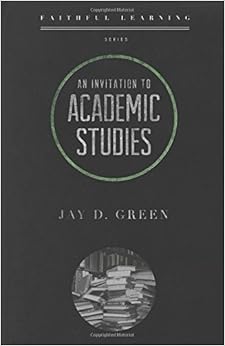
This actually has nothing to do with painting. The title was just a conspiracy to get you reading this. When teachers head back to school, much of the focus lands on lesson plans, counting desks to make sure you have enough, and navigating through the maze of orientation meetings with other staff. But the best question we teachers can ask at this time--especially those who teach within the Christian academy--is "Why are we here?"
To this end, the faculty at my present employer, Westminster Christian Academy, read two short books over the summer (at least, we all were supposed to have read them!), one of them pictured above: Jay Green's An Invitation to Academic Studies. Green is professor of history at my alma mater, Covenant College, although he arrived six years after my graduation. To answer the question "Why are we here?", Green looks at various strategies that well-meaning believers have tried in regards to academia (he focuses mainly on college studies, but there are ramifications here for secondary education, too). Then Green proposes a powerful--and in my view, a biblical, alternative.
Green begins with the ancient church father Tertullian and his famous/infamous quote, "What has Jerusalem to do with Athens, the Church with the Academy, the Christian with the heretic?...After Jesus we have no need of speculation, after the Gospel no need of research." I confess to twitches of pain and convulsions of embarrassment whenever I see that quote. Green lays out several strategies that Christian have historically taken with regards to academics and faith.
1. Avoid higher education altogether: This is the idea that pursuing serious study in a collegiate setting can ruin a young person's faith.
2. Defensive engagement: Entering university studies must be undertaken with sober judgment, so students must take care to preserve their Christian worldview while in college environments that can be hostile to their faith.
3. Dualism: Christian faith and academic study exist in separate spheres. Faith is of interest to the faithful, while the common kingdom of academic study has more of a pull for non-redeemed humankind.
4. Jerusalem transforming Athens: The cause of the faith is to renew and change educational pursuits of every kind, where students are "agents of renewal" in the world by virtue of their Christian education.
While respecting whatever merits reside within these strategies, Green opts for his alternative proposal: Academic disciplines are "gifts from God, can help us to cultivate a deeper love for God and our neighbors--an alternative that not only is interested in what we Christians are doing for our academic disciplines, but also asks what the academic disciplines might be doing for us as Christians."
Green's proposal has biblical merit, both didactically and through the example of historical narrative. In I Timothy 4:4, St. Paul--an academic cleric himself--says "everything created by God is good, and nothing is to be rejected if it is received with thanksgiving, for it is made holy by the word of God and prayer." What are academic disciplines like history, mathematics, engineering, biology, German, literature, and the like but portals to the creation of God and what he has imbued in humankind? Yes, fallen humankind...I get that. But this world is still good and bears the brushstrokes of a Creator calling humanity back to himself. Why wouldn't we want to plunge into the details of this groaning planet and our robust yet vandalized existence? All this has something to teach us about fidelity to God in his world.
Not to mention, if there is anything the story of Daniel teaches us in Scripture (aside from the fact you can have a pretty exciting career as a federal government official), it's that the participation of godly people in academic studies matters. Daniel and his three co-exiled buddies were put in the honors program in Babylon, far from home, far from faithful nurture. But Daniel didn't take an avoidance approach, bunker down in defensive engagement, or radically say "This part is God's, this belongs to Babylon." No, he and his friends participated in the pagan training, learning the literature, language, history and (most likely) the religion of the Babylonians (Daniel 1:3-4). And God gave them both learning (worldview) and wisdom (skill) in these subject areas [Daniel 1:17], to where Daniel and company were head and shoulders above the rest (1:19-20). Why would God have done this unless what they learned was of no benefit to their faithful existence?
It's something to consider. Consider also--if you're a Christian school teacher-- having this discussion with others. Snag an administrator, a fellow teacher, a student, and a parent and ask them, "What seems to be our goal here at _____ Christian School? What are we doing here? What should we be doing here?"
It might be fascinating what kind of answers you get.
-------------------------------------------------------------------------------
Selected quotes from An Invitation to Academic Studies
"The point here is not that worldview thinking within the disciplines is unimportant compared to disciplinary knowledge...But if such 'worldview' issues are the first or most important considerations raised, or if, in pursuing them, we believe we have exhausted our academic responsibility before God, then I believe we dishonor the disciplines and ironically strip them of the power and promise they hold for us and for God's kingdom."
"How would our pursuit of learning in college change if we were to envision the academic disciplines not so much as adversaries in need of fixing or censoring but as genuine gifts from our gracious God?"
"The academic disciplines are both extensions of creation and one of the most consequential ways in which we exercise dominion over that which God has made."
"A worldview mastery of a craft is no substitute for mastery of the craft itself."
"It is accordingly helpful to see each academic discipline as extending a kind of basic knowledge, a set of distinctive skills, and a variety of virtues, all of which require our careful attention and our labors."
"We need to move these fields of study conceptually back within the bounds of creational goodness where they belong and allow ourselves to be amazed and thrilled by the worlds of joyful discovery that they open to us when we enter them with this kind of expectation. This sense of wonder can't help but overflow into gratitude to God."
Wednesday, August 5, 2015
Remembering Uncle Bob
This past Saturday dawned much like any other day, but within a few hours, the sun's rays didn't seem as bright as usual.
In a hospital in Greensboro, North Carolina, my Uncle Bob, who had hung on for over ten weeks after suffering a traumatic brain injury, finally came to the end of his earthly journey.
Uncle Bob had been doing what he loved, bicycling around the area, when he had his accident and suffered his injury. And that probably gives us a window into Uncle Bob. It seemed that whatever he was up to, he was doing something he loved.
Whether it was taking a walk through the nearby arboretum, dabbling in photography, taking one of his dedicated long-distance runs, biking across states like North Carolina or Kansas, playing with his grandchildren, or finding ways to heal the struggles and fissures in marriages, I think it's fair to say Uncle Bob found joy in each journey.
Over the years of my own existence, there has been plenty of opportunity to know and enjoy Bob, whom I knew probably the most out of all my uncles. It went beyond visits during Thanksgiving or Christmas holidays. Once during a sabbatical in Atlanta, Bob flew over to Mississippi to spend time with my folks and it coincided with my seminary fall break. And October mornings in Mississippi are some nice hours to spend some four-mile runs with Uncle Bob.
But it was when we lived geographically closer to Bob and Aunt Judy that we were most appreciative. When I was a pastor in North Carolina, I found the going difficult and--honestly--depressing. It was hard recognizing the greatest resistance to the Gospel could come from people you were trying to lead, and I couldn't find a way out of that darkness. During those two difficult years, I think it's fair to say that thanks to Bob and Judy's kindness and consistent encouragement, we managed to make it through to the next vocational step. The encouragement didn't stop when we moved away. When I published my first novel in 2013, Bob sent an email about how much he enjoyed reading it (even saying it left other well-known authors in the dust, a comment that humbled me and I continue to prize).
It's also fair to say that throughout his life, Uncle Bob found a way to be a healer. He recognized soon after entering the pastorate that he'd be wise to train in marriage and family counseling, and that decision eventually led him to over three decades of service as the director of a counseling center in Greensboro (which he founded). I attended one of his training seminars for clergy when we were living in North Carolina, and I manage to bring in a number of those principles even in teaching when talking to kids about relationships and preparation for life. Uncle Bob believed so much in the importance of marriage that he wrote about it. In marked contrast to a society that preached personal fulfillment and reckless individualistic happiness, Uncle Bob calmly but definitively lifted the banner of promise keeping. It is not making ourselves overjoyed that makes us human, he indicated. Rather, faithfulness, monogamy, and the stubborn and steadfast love of another is what empowers us to flourish. The Piedmont Triad area of North Carolina has many marriages that have been prepared and repaired because Uncle Bob held consistently to this mantra.
It wasn't just couples that Uncle Bob sought to help, but also those fraught with scarcity. His work with Bread for the World underscored his concern for others to have the basic needs of food and sustenance. So much of that was behind the scenes, but it was passionate living out of his beliefs all the same.
A life of passion, a life of hope. I think it's altogether appropriate that one who lived his earthly days as a healer for others has now received his complete healing from the Great Physician, and one who has given wisdom to others has entered the presence of the Wonderful Counselor (Isaiah 9).
Uncle Bob, thank you for a life well lived. And it's been humbling I was able to intersect with it.
In a hospital in Greensboro, North Carolina, my Uncle Bob, who had hung on for over ten weeks after suffering a traumatic brain injury, finally came to the end of his earthly journey.
Uncle Bob had been doing what he loved, bicycling around the area, when he had his accident and suffered his injury. And that probably gives us a window into Uncle Bob. It seemed that whatever he was up to, he was doing something he loved.
Whether it was taking a walk through the nearby arboretum, dabbling in photography, taking one of his dedicated long-distance runs, biking across states like North Carolina or Kansas, playing with his grandchildren, or finding ways to heal the struggles and fissures in marriages, I think it's fair to say Uncle Bob found joy in each journey.
Over the years of my own existence, there has been plenty of opportunity to know and enjoy Bob, whom I knew probably the most out of all my uncles. It went beyond visits during Thanksgiving or Christmas holidays. Once during a sabbatical in Atlanta, Bob flew over to Mississippi to spend time with my folks and it coincided with my seminary fall break. And October mornings in Mississippi are some nice hours to spend some four-mile runs with Uncle Bob.
But it was when we lived geographically closer to Bob and Aunt Judy that we were most appreciative. When I was a pastor in North Carolina, I found the going difficult and--honestly--depressing. It was hard recognizing the greatest resistance to the Gospel could come from people you were trying to lead, and I couldn't find a way out of that darkness. During those two difficult years, I think it's fair to say that thanks to Bob and Judy's kindness and consistent encouragement, we managed to make it through to the next vocational step. The encouragement didn't stop when we moved away. When I published my first novel in 2013, Bob sent an email about how much he enjoyed reading it (even saying it left other well-known authors in the dust, a comment that humbled me and I continue to prize).
It's also fair to say that throughout his life, Uncle Bob found a way to be a healer. He recognized soon after entering the pastorate that he'd be wise to train in marriage and family counseling, and that decision eventually led him to over three decades of service as the director of a counseling center in Greensboro (which he founded). I attended one of his training seminars for clergy when we were living in North Carolina, and I manage to bring in a number of those principles even in teaching when talking to kids about relationships and preparation for life. Uncle Bob believed so much in the importance of marriage that he wrote about it. In marked contrast to a society that preached personal fulfillment and reckless individualistic happiness, Uncle Bob calmly but definitively lifted the banner of promise keeping. It is not making ourselves overjoyed that makes us human, he indicated. Rather, faithfulness, monogamy, and the stubborn and steadfast love of another is what empowers us to flourish. The Piedmont Triad area of North Carolina has many marriages that have been prepared and repaired because Uncle Bob held consistently to this mantra.
It wasn't just couples that Uncle Bob sought to help, but also those fraught with scarcity. His work with Bread for the World underscored his concern for others to have the basic needs of food and sustenance. So much of that was behind the scenes, but it was passionate living out of his beliefs all the same.
A life of passion, a life of hope. I think it's altogether appropriate that one who lived his earthly days as a healer for others has now received his complete healing from the Great Physician, and one who has given wisdom to others has entered the presence of the Wonderful Counselor (Isaiah 9).
Uncle Bob, thank you for a life well lived. And it's been humbling I was able to intersect with it.
Subscribe to:
Posts (Atom)