At the intersection of writing and life with the author of the Cameron Ballack mysteries

Tuesday, August 25, 2015

Ballack Is Back!

It's true! In one week, The Broken Cross will be available on Amazon Kindle, with the paperback to come out a few weeks later. So that's September 1st for the ebook release, which will make a sweet belated birthday gift for me!

Here's the synopsis from the back cover:
A place of solitude, prayer and reflection becomes a place of death as the Catholic Church's lead attorney is brutally murdered in St. Louis' Cathedral Basilica just days after winning a prominent case. 

Within hours, Cameron Ballack is appointed the Special Investigative Division team’s lead detective. The wheelchair-bound Ballack, and his new team, must battle secrecy, depravity and deception as they begin to uncover an unholy reign of illicit behavior that has triggered one killing after another.

Connecting horrors of the past with the case at hand, Ballack gambles everything in a union of logic and intuition to ensnare the murderer. But as the killer’s intentions reach a critical mass, will Ballack and his team be able to stop this evil crusade before more lie dead before the altar of past sins?

More news as we approach the release date! And thanks for all your encouragement as we bring this story to you.

Friday, August 7, 2015

Back to School: Painting Things Green


This actually has nothing to do with painting. The title was just a conspiracy to get you reading this. When teachers head back to school, much of the focus lands on lesson plans, counting desks to make sure you have enough, and navigating through the maze of orientation meetings with other staff. But the best question we teachers can ask at this time--especially those who teach within the Christian academy--is "Why are we here?"

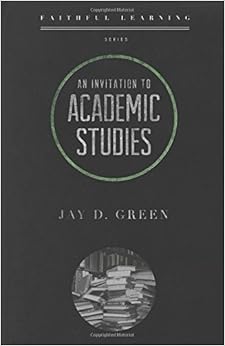
To this end, the faculty at my present employer, Westminster Christian Academy, read two short books over the summer (at least, we all were supposed to have read them!), one of them pictured above: Jay Green's An Invitation to Academic Studies. Green is professor of history at my alma mater, Covenant College, although he arrived six years after my graduation. To answer the question "Why are we here?", Green looks at various strategies that well-meaning believers have tried in regards to academia (he focuses  mainly on college studies, but there are ramifications here for secondary education, too). Then Green proposes a powerful--and in my view, a biblical, alternative.

Green begins with the ancient church father Tertullian and his famous/infamous quote, "What has Jerusalem to do with Athens, the Church with the Academy, the Christian with the heretic?...After Jesus we have no need of speculation, after the Gospel no need of research." I confess to twitches of pain and convulsions of embarrassment whenever I see that quote. Green lays out several strategies that Christian have historically taken with regards to academics and faith.

1. Avoid higher education altogether: This is the idea that pursuing serious study in a collegiate setting can ruin a young person's faith.
2. Defensive engagement: Entering university studies must be undertaken with sober judgment, so students must take care to preserve their Christian worldview while in college environments that can be hostile to their faith.
3. Dualism: Christian faith and academic study exist in separate spheres. Faith is of interest to the faithful, while the common kingdom of academic study has more of a pull for non-redeemed humankind.
4. Jerusalem transforming Athens: The cause of the faith is to renew and change educational pursuits of every kind, where students are "agents of renewal" in the world by virtue of their Christian education.

While respecting whatever merits reside within these strategies, Green opts for his alternative proposal: Academic disciplines are "gifts from God, can help us to cultivate a deeper love for God and our neighbors--an alternative that not only is interested in what we Christians are doing for our academic disciplines, but also asks what the academic disciplines might be doing for us as Christians."

Green's proposal has biblical merit, both didactically and through the example of historical narrative. In I Timothy 4:4, St. Paul--an academic cleric himself--says "everything created by God is good, and nothing is to be rejected if it is received with thanksgiving, for it is made holy by the word of God and prayer." What are academic disciplines like history, mathematics, engineering, biology, German, literature, and the like but portals to the creation of God and what he has imbued in humankind? Yes, fallen humankind...I get that. But this world is still good and bears the brushstrokes of a Creator calling humanity back to himself. Why wouldn't we want to plunge into the details of this groaning planet and our robust yet vandalized existence? All this has something to teach us about fidelity to God in his world.

Not to mention, if there is anything the story of Daniel teaches us in Scripture (aside from the fact you can have a pretty exciting career as a federal government official), it's that the participation of godly people in academic studies matters. Daniel and his three co-exiled buddies were put in the honors program in Babylon, far from home, far from faithful nurture. But Daniel didn't take an avoidance approach, bunker down in defensive engagement, or radically say "This part is God's, this belongs to Babylon." No, he and his friends participated in the pagan training, learning the literature, language, history and (most likely) the religion of the Babylonians (Daniel 1:3-4). And God gave them both learning (worldview) and wisdom (skill) in these subject areas [Daniel 1:17], to where Daniel and company were head and shoulders above the rest (1:19-20). Why would God have done this unless what they learned was of no benefit to their faithful existence?

It's something to consider. Consider also--if you're a Christian school teacher-- having this discussion with others. Snag an administrator, a fellow teacher, a student, and a parent and ask them, "What seems to be our goal here at _____ Christian School? What are we doing here? What should we be doing here?"

It might be fascinating what kind of answers you get.

-------------------------------------------------------------------------------
Selected quotes from An Invitation to Academic Studies

"The point here is not that worldview thinking within the disciplines is unimportant compared to disciplinary knowledge...But if such 'worldview' issues are the first or most important considerations raised, or if, in pursuing them, we believe we have exhausted our academic responsibility before God, then I believe we dishonor the disciplines and ironically strip them of the power and promise they hold for us and for God's kingdom."

"How would our pursuit of learning in college change if we were to envision the academic disciplines not so much as adversaries in need of fixing or censoring but as genuine gifts from our gracious God?"

"The academic disciplines are both extensions of creation and one of the most consequential ways in which we exercise dominion over that which God has made."

"A worldview mastery of a craft is no substitute for mastery of the craft itself."

"It is accordingly helpful to see each academic discipline as extending a kind of basic knowledge, a set of distinctive skills, and a variety of virtues, all of which require our careful attention and our labors."

"We need to move these fields of study conceptually back within the bounds of creational goodness where they belong and allow ourselves to be amazed and thrilled by the worlds of joyful discovery that they open to us when we enter them with this kind of expectation. This sense of wonder can't help but overflow into gratitude to God."

Wednesday, August 5, 2015

Remembering Uncle Bob

This past Saturday dawned much like any other day, but within a few hours, the sun's rays didn't seem as bright as usual.

In a hospital in Greensboro, North Carolina, my Uncle Bob, who had hung on for over ten weeks after suffering a traumatic brain injury, finally came to the end of his earthly journey.

Uncle Bob had been doing what he loved, bicycling around the area, when he had his accident and suffered his injury. And that probably gives us a window into Uncle Bob. It seemed that whatever he was up to, he was doing something he loved.

Whether it was taking a walk through the nearby arboretum, dabbling in photography, taking one of his dedicated long-distance runs, biking across states like North Carolina or Kansas, playing with his grandchildren, or finding ways to heal the struggles and fissures in marriages, I think it's fair to say Uncle Bob found joy in each journey.

Over the years of my own existence, there has been plenty of opportunity to know and enjoy Bob, whom I knew probably the most out of all my uncles. It went beyond visits during Thanksgiving or Christmas holidays. Once during a sabbatical in Atlanta, Bob flew over to Mississippi to spend time with my folks and it coincided with my seminary fall break. And October mornings in Mississippi are some nice hours to spend some four-mile runs with Uncle Bob. 

But it was when we lived geographically closer to Bob and Aunt Judy that we were most appreciative. When I was a pastor in North Carolina, I found the going difficult and--honestly--depressing. It was hard recognizing the greatest resistance to the Gospel could come from people you were trying to lead, and I couldn't find a way out of that darkness. During those two difficult years, I think it's fair to say that thanks to Bob and Judy's kindness and consistent encouragement, we managed to make it through to the next vocational step. The encouragement didn't stop when we moved away. When I published my first novel in 2013, Bob sent an email about how much he enjoyed reading it (even saying it left other well-known authors in the dust, a comment that humbled me and I continue to prize).

It's also fair to say that throughout his life, Uncle Bob found a way to be a healer. He recognized soon after entering the pastorate that he'd be wise to train in marriage and family counseling, and that decision eventually led him to over three decades of service as the director of a counseling center in Greensboro (which he founded). I attended one of his training seminars for clergy when we were living in North Carolina, and I manage to bring in a number of those principles even in teaching when talking to kids about relationships and preparation for life. Uncle Bob believed so much in the importance of marriage that he wrote about it. In marked contrast to a society that preached personal fulfillment and reckless individualistic happiness, Uncle Bob calmly but definitively lifted the banner of promise keeping. It is not making ourselves overjoyed that makes us human, he indicated. Rather, faithfulness, monogamy, and the stubborn and steadfast love of another is what empowers us to flourish. The Piedmont Triad area of North Carolina has many marriages that have been prepared and repaired because Uncle Bob held consistently to this mantra.

It wasn't just couples that Uncle Bob sought to help, but also those fraught with scarcity. His work with Bread for the World underscored his concern for others to have the basic needs of food and sustenance. So much of that was behind the scenes, but it was passionate living out of his beliefs all the same.

A life of passion, a life of hope. I think it's altogether appropriate that one who lived his earthly days as a healer for others has now received his complete healing from the Great Physician, and one who has given wisdom to others has entered the presence of the Wonderful Counselor (Isaiah 9).

Uncle Bob, thank you for a life well lived. And it's been humbling I was able to intersect with it.

Tuesday, July 21, 2015

Between The Pages with "Sidney Chambers and the Forgiveness of Sins"


I'd say it's about time I did a book review. It has been a summer of heavy reading: I've bulldozed through the Shakespearean tragedies of King Lear, Hamlet, Othello, and Macbeth. I greatly enjoyed Icelandic crime fiction novelist Arnauldur Indriadson's Hypothermia, and presently I am working my way through Dante's Divine Comedy. So the winner of today's book review blog post is...

If you guessed "none of the above", you'd be right.

James Runcie remains one of the great treasures of literary minds today. I stumbled across his Sidney Chambers and the Shadow of Death three years ago and was taken with how delightfully well-written this gentlemanly clergyman cozy mystery was framed. After cutting my teeth on detective fiction novel after novel, it was a refreshing change of pace to come across a book with a general story arc connected by six loosely threaded short stories with the same core main characters. I have since devoured his following three books in the Grantchester Mysteries, bringing us through this year's edition, Sidney Chambers and the Forgiveness of Sins. (In fact, if you have avoided Grantchester on PBS to enjoy the spirit of these stories on the small screen, I seriously question your choice of cultural entertainment)

This most recent work is a beauty of a page turner without feeling too quick of a pace. Runcie, the son of former (1980-1991) Archbishop of Canterbury, Robert Runcie, knows the world of the Church of England clergyman. He portrays Chambers as a gentle, knowledgeable soul with a discernible love of his parishioners, a desire to see the best in others, and an ability to pull secrets out of others when the police can't.

When the series began, Sidney Chambers was 32 and unmarried. Now, having navigated through the undulations of his friendship with Amanda Kendall, marriage to German widow Hildegard Staunton, and tense moments with Inspector Geordie Keating, Sidney is moving through mid-life with wife and daughter and accepts a promotion as Archdeacon of Ely, taking him from the small town of Grantchester where he had served.

Runcie continues his classy and lyrical prose, drawing the reader into the world of Britain's metamorphosis from Elizabeth II's coronation onward. One thing I've greatly enjoyed is how Runcie paints the labors of sleuthing on the canvas of the times. Whereas today is an age when people are all too eager to share everything about themselves through social media--whether it be getting tickets to a ball game or about laughing Coke through their nose at lunch--in Chambers' day, folks were more reserved about divulging private details. Too much openness could be rude. It is an age when homosexuality was still prosecuted and racism was ugly in small towns. Runcie brings these realities to bear in his stories, brushing in (along the way) Sidney's experiences in historical events as the Berlin Wall goes up, C.S. Lewis is laid to rest, and England wins the 1966 World Cup.

In the meantime, Sidney finds time to help investigate the apparent murder of a Russian musician, the domestic abuse of a country hostess, poison pen letters to his friend Amanda, the "accidental" death of a Cambridge musician under the weight of a piano, a blown-up science wing of a school, and the theft of a painting during a Florentine vacation.

The fiction is always gripping, but there is much realism that draws the reader in. Sidney struggles with the obsession of sleuthing that he neglects much of his parish duties, not to mention his family, leading to a confrontation with Hildegard. His foibles and flaws, far from leading to disgust, are drawn for the sake of authenticity. This is a man who struggles with his priorities, who knows he is a priest swimming in a desperate current (sometimes of his own making), but one who desires to be a good man seeking to bring faith and hope to those under his care.

In short, the cozy mystery with the British gentleman detective is back in full force. One could call it "Father Brown meets the changing tides of British culture" but truly Runcie has done more than merely dovetail what has come before. He has created an emerging tradition of humane suspense within the fabric of period mystery and drama, and one that deserves the highest accolades.

And I guarantee it is an effort I will hail again at this time next year when the fifth volume in the Grantchester Mysteries arrives. Thank you, James, in advance.

Sunday, July 19, 2015

Book Fairs, a.k.a. We Interrupt This Blog

One of the occupational hazards of being a bibliophile is that you're a sucker for book fairs.

The Friends of St. Charles County Library held their annual book fair at the St. Charles Convention Center this weekend, and we made two trips. The first was opening day, when hardbacks were $2 each and paperbacks were 50 cents.

On that day, Christy, Lindsay, and I made a haul of twelve books, including...

- Selected Writings of Washington Irving
- John Milton's L'Allegro, Il Penseroso, Comus and Lycidas
- Gray's Anatomy
- The Outline of History by H.G. Wells
- The Decline and Fall of the Roman Empire by Edward Gibbon
- St. Thomas Aquinas' Summa Theologica
- Dante's Divine Comedy

Yes, it was a good day.

Then came the final day of the fair, when Joshua and I went back for the $10-for-all-the-books-you-can-stuff-in-a-box closing sale.

What did we snag for a dead Hamilton?

- a William Faulkner collection
- Mary Shelley's Frankenstein
- The Pocket Book of Great Detectives with stories featuring Father Brown, Sherlock Holmes, Poirot, C.A. Dupin, and Lord Peter Wimsey (and Alfred Hitchcock wrote the preface!)
- Night by Elie Wiesel
- Corrie Ten Boom's Prison Letters
- John Berendt's Midnight in the Garden of Good and Evil
- a couple of Shakespeare classics in Julius Caesar and Henry V
- a Russian classic trifecta in Dostoevsky's Crime and Punishment, Solzhenitsyn's The Gulag Archipelago, and Tolstoy's War and Peace (might finish those in 2025!)
- A Man for All Seasons (clearly I'm a St. Thomas More fan)
- JFK's Profiles in Courage
- Brave New World by the provocative Aldous Huxley
- Martin Luther's Small Catechism and a separate German grammar for Josh, as well as a decently recent American history textbook for this school year
- Greg Laurie's Why Believe? for some Christian apologetics grist
- Modern Times by Paul Johnson
- Thomas Keneally's Schindler's List (yes, the novel that became the bestselling movie)
- Anthony Trollope's Barchester Towers
- a collection of Victorian poetry
- Mark Twain's The Adventures of Huckleberry Finn
- J.R.R. Tolkien's Unfinished Tales
and finally and happily...
- Blaise Pascal's Pensees

Best ten dollars ever spent.

If you're ignorant of book fairs, you don't know what you're missing. In a world that is becoming less and less historically, culturally, and functionally literate, people need to get out there, maximize their personal libraries, and rise above the tides of ignorance.

Just saying'......

Tuesday, July 14, 2015

Believable Characters > Characters With Belief

As informative as Dick Cheney might be in reacting to the Iran nuke deal right now, I have to say there's other things I'd rather do.

A blog post seems about right.

I've spent a good bit of time updating email lists and writing book promos for the release of my upcoming sequel in the Cameron Ballack Mysteries, The Broken Cross, and all that has caused me to recall some reactions to my first book, Litany of Secrets. I'll mention one tonight and then another in a couple days.

One came from the father of a student. It was in a conversation of several clustered assertions and questions. Jim was the first one to ask me if I had been greatly influenced by British crime fiction, and so of course, I pled guilty (thank you, P.D. James, Dorothy Sayers, and James Runcie). Then the conversation turned to characters, specifically Cameron Ballack himself, and Jim's confession came rushing out.

"You know," he said, "as the story went along, I both understood why Ballack was a skeptic, given his situation. But I was so sure that he would come to a moment of faith at some point in the story."

Interesting, I thought, wondering if this was the "Why-an-agnostic-for-your-protagonist" talk or the "Is-this-a-Christian-novel-or-not" talk. But Jim went on.

"Yet as the story went on," he continued, "I thought, 'No, that wouldn't be good. It would be too soon. And a conversion doesn't have to happen. In fact, I felt that if Ballack came to some point of saving faith at any point, it might ruin his character."

Wow, I thought, amazed at how much Jim's thoughts echoed my own as I have mapped out that novel. I don't think that has to do with the idea that Christians are less enjoyable, less well-rounded, or less vibrant individuals than the general population...at least I hope not. However...

1. Forcing a condition of spiritual regeneration on a character (especially a main character) means treading in dangerous territory. Some authors can manage a "faith turn" and shepherd their character through the book very well (Witness Glynn Young's work in Dancing Priest), but this takes an author who can walk that tightrope well. To make someone flip the switch and become a Christian for the principle of having a stock Christian beacon as a character does an injustice to the story. 

2. It's more important to have believable characters in your story than to have characters who believe the Christian faith. That sounds tragic to some ears, but it's true. In penning Cameron Ballack as a wheelchair-bound detective, I was taking a risk, committing a considerable stretch as it was. The fact that so many places are handicapped-accessible now makes a disabled sleuth more credible, but I want to keep Ballack's character as realistic as possible. This means having the rough edges some detectives have, but also asking the questions and having many resistances to easy answers that many people might have.

3. I'm a Christian, but my job is not to mirror the Christian story, or to have my novels be allegories of the Christian life (Besides, John Bunyan already did yeoman's work on that with Pilgrim's Progress). The truth is, the fabric of creation, ruin, redemption, and restoration is woven in human experience. The stories we tell in books and movies tends to follow this arc anyway. All I have to do is write a great story, and the connections to our human experience should take care of themselves.

Wednesday, July 1, 2015

Classy Dispositions on the Tiber River

I don't know you happen to be a fan of Dan Brown's novels. I read everything up through The Lost Symbol and I haven't gotten around to reading Inferno. I tend to be restrained in any criticism of Brown's work, mainly because I know as a writer that stitching together a novel takes a lot of work. However, I don't need good eyes to read some of the more searing critiques of Brown's work. One snag is that Brown plunks together too many can-you-top-this moments with so many tight squeezes that the whole storyline groans under the weight of implausibility. To this I say: They're novels. The thriller element demands some of what he injects. Either disbelieve him or move on through the story. The second item some take issue with is (first in Angels and Demons and especially in The DaVinci Code) what seems to be a grating anti-Catholicism. Brown himself is Catholic and claims to be a faithful Catholic, but I can see how many find to much anti-Vatican edginess in his stories.

I guess you could say that Brown, being Catholic, has the right to poke fun. I don't know. I'm not Catholic, but I am determined never to be someone mistaken for a Vatican hater.

One thing in which I was burdened in soul to do was share some details of my upcoming novel, The Broken Cross. Whereas Litany of Secrets utilized a setting of an Eastern Orthodox seminary, The Broken Cross takes place all over St. Louis but is entrenched in the cloaked and uncloaked intrigue of the Archdiocese of St. Louis. I knew I'd have some number of Catholic readers, but there were some I thought I needed to speak with above all.

Mike is a friend for nearly twenty-five years. Born Catholic, he declared Gospel free agency and became a Presbyterian (serving as a elder in a couple churches) before reconverting (is that a word?) back to Roman Catholicism. William teaches at a Catholic seminary in Minnesota; I've known him for only a couple years but I greatly respect his insight and wisdom. Deb is my former English teacher, and she more than anyone is the reason why I love writing today. She is a lifelong Catholic, a product of Catholic schools...let's face it, she knows every brick on the Roman Road.

All three people I respect. I wanted them to know the general contours of my upcoming novel. And I wanted them to know my intentions. So I emailed them all at once:

"Within the storyline, there are references to a fictionalized religious order and a lay movement that injects some of the tragic backstory to the main plot. Some of that includes financial impropriety and the haunting resonation of sexual abuse scandal, although the details are very toned down. My purpose in doing this is not to fire shots at the Vatican a la Dan Brown, but simply to make a story that bears many wounds both realistic and, eventually, redemptive. I can say that the way the story begins in my author’s note begins this hope where I tell readers “[D]o not interpret The Broken Crossas a punchy diatribe against the Catholic Church. An institution of more than one billion followers will have ample faults among its leadership and lay members. To its credit, the Vatican has owned up to a number of its failings.” The story ends in a way that depicts the RCC as honest, forthright, and somewhat heroic.

As a Protestant, I know my own tradition is fraught with wounds, scars, warts, and the brokenness that comes from being a group of sinful people on a common but frail mission together. Although I’ve referenced the Eastern Orthodox tradition in Litany of Secrets and Catholicism in The Broken Cross, the varieties of Protestant expression are within my literary rifle sights in upcoming volumes. And one would argue my criticism of my own spiritual family within those books is more pointed. We’ll see, if we ever get to those for publication. I’m sure much will be in the eye of the beholder. I simply want you three to know for sure that whatever troubling matters occur within my story, they are for the sake of story, not to excoriate the RCC, and the story heads in a direction which I hope eventually shows my appreciation for the RCC.

But I wanted to share the details of my upcoming release with the three of you, mainly due to the respect I have for you and for the intellectual and spiritual vigor you have given and continue to give me as a fellow pilgrim on God’s road. Most grateful I am that we are part of this family tree of faith and that through the gift of story, we can come to grips with faith in newer and bolder ways.

“We also have to admit that we are a bunch of sinners in pursuit of salvation. And when we experience salvation, we’re also able to lead others to it. I’m not saying that everybody needs to be a public sinner before we can preach about God’s grace, but if anybody should stumble and fall, that should not be the last word. Stumbling and falling is an invitation for us to hold on more firmly to the hand of God.” (Cardinal Peter Turkson)

Many thanks for your time spent reading this, for your faith, and for your prayers as I continue to explore my own."

Their responses? Nothing short of amazing. Absolutely full of grace and class.

One said: "Please set your mind at ease about the way in which Catholics or the Church are depicted. I think I'm safe in saying that you would be almost constitutionally incapable of communicating contempt or scorn for the RCC. In any case, the sins of her members are the reason she exists at all, eh?

Another: "As a writer telling a story, it must have context and backdrop to be believable...Including events ripped from the headlines concerning the RCC as the backdrop is certainly appropriate. I have spent a good bit of time in [places like these where] I found more challenges to my faith than I have ever encountered in newspapers or novels."

The third: "I agree...that I would not question your motives, either, because...[t]here is no denying the RCC is fraught with scandal and impropriety, but knowing you, you did not write this book to exploit or condemn."

I'm sure my friends appreciated being brought into the loop about my specific intentions. But just the same, I am profoundly appreciative of their sensitivity and understanding. To hear that from them meant the world to me.

In his novel South of Broad, Pat Conroy once said, "There is a lot wrong with the Catholic Church, but my people know how to put on a show." This is no mere show, with all due respect. There are flaws in faith communities, to be sure, and the Catholic Church may be one of them, but I have experienced class and grace from its people. 

Mike, William, and Deb...Many thanks.